
The Empty Chair
Spaghetti night at my house
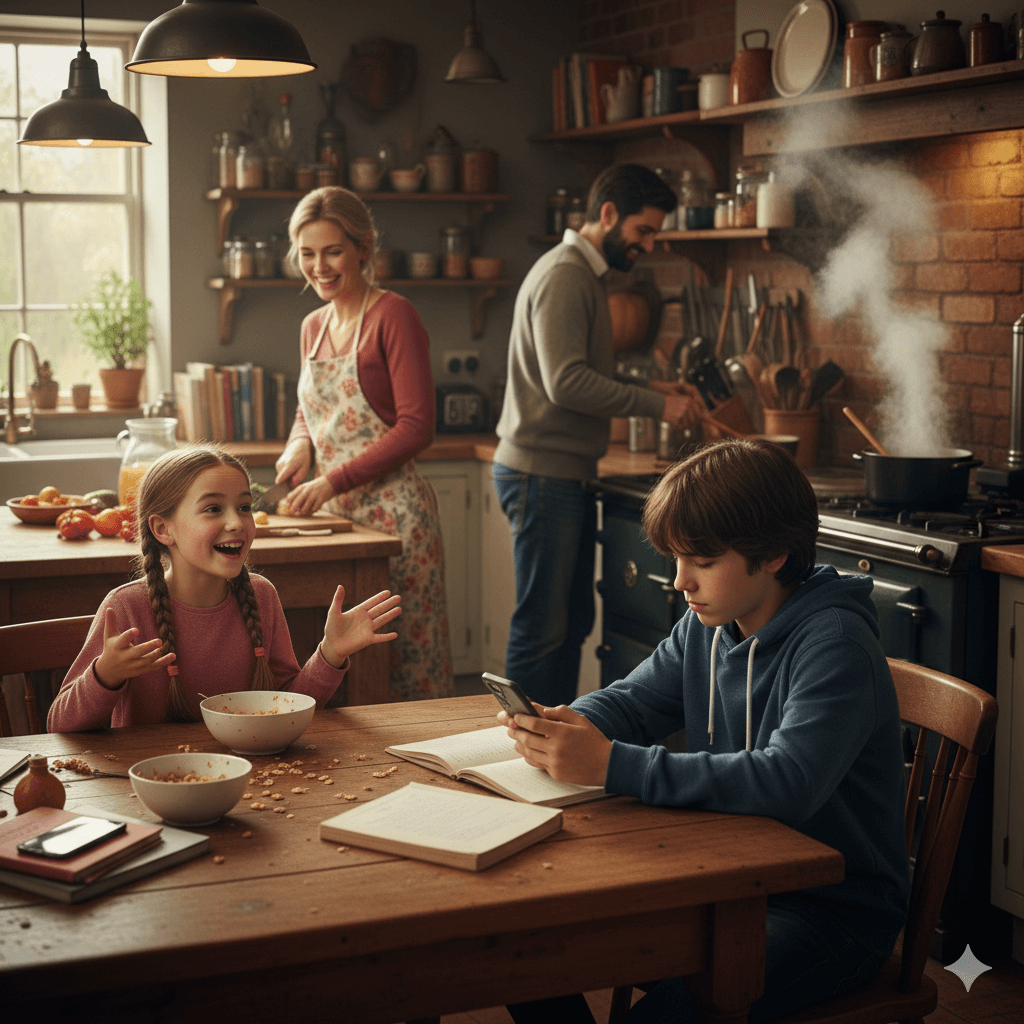
The kitchen air was thick with the scent of garlic and the heavy humidity of boiling pasta water. It should have been the highlight of the day—a moment for the family to gather and connect. Instead, the air was thick with a different kind of tension.
My daughter, Katherine was recounting a school drama with the intensity only a 12 year old could do. My son, Gerry was physically present, but his eyes were cast downward, fixed on the glowing rectangle of his phone tucked at the table.
My wife, Liz, wasn't talking to me—again; her silence was a wall; Not sure why but perhaps I’d upset her with a thoughtless, rushed word earlier that day and the wound was still fresh.
And me? I was the "master of ceremonies." At least, that’s what I told myself. I was juggling a wooden spoon in my left hand and the dog’s leash in my right, as our golden retriever sensed the tension and paced the linoleum.
At the same time, I was trying to read a "critical" work email on my phone, propped up on the counter, tilting my chin at an awkward angle to scroll.
I thought I was a hero. I thought I was multitasking. I thought I was "doing it all."
Then, the quiet hit.
Katherine finished her story—one that clearly required a father’s empathy or wisdom—and no one responded. I didn’t look up in time. Gerry didn't hear a word. Liz just gave me her most frightening death stare.
I finally looked up from my screen and the expression on Katherine’s face wasn't anger. It was worse. It was "flat." She had simply given up on being heard. At that moment, I saw something truly terrifying:
An empty chair at a full table.
I was sitting right there. My weight was in the seat. My hand was holding the spoon. But I was a ghost. I was physically occupying space, but it was entirely empty of my true presence.
The theory of family relativity
In physics, we learn time is relative. In family life, we often treat time as if it’s an infinite resource—a vast ocean that will always be there. We tell ourselves we’ll connect "eventually."
We hope a big, beautiful block of "quality family time" will magically appear on the calendar next month, or perhaps next year when things "slow down."
But as I came to realise that night, hope is not a strategy. Things happen and the unexpected can happen at any time - it’s inevitable.
The biggest barrier to connection isn't just the smartphones at the table; they’re merely symptoms. The real culprit is an unorganised mind. When we’re disorganised, our brains operate like a radio stuck between stations—lots of noise, not much music - static interference.
It’s almost impossible to be fully engaged with even the people most dear and important to you when your mind is humming with the low-level anxiety of "unfinished business." Even when we put the phone down, the static remains. It looks like this:
Home projects: You’re looking at your son, but you’re thinking about that leaky tap in the ensuite or the overgrown garden hedge. These small, unmanaged tasks whisper to you from the background, demanding attention even when you’re supposed to be "off the clock."
Work: You’re nodding along to a story, but you’re secretly composing the "perfect" reply to a difficult colleague in your head. You think you’re hiding it, but your eyes are glazed and your family can see you’ve checked out.
Next week: The unwritten list of medical appointments, social obligations and errands. Without a dedicated, organised place for these logistics, they float around in your brain like space debris, colliding with your attempts at meaningful conversation.
Investing in the heart
That night, as the spaghetti grew cold, I realised I was giving the people who matter most my mental leftovers. I was giving my "best self" to my inbox and my "shadow self" to my family.
The realisation hit me like a splash of cold water: You can’t deposit memories in a bank, but you can invest in the hearts of your loved ones. The dividends of that investment are the only things that truly matter. But to make that investment, you have to be present for the transaction. You have to clear the "background noise" of the day to make room for the foreground moments.
Presence is not a gift you give once; it’s a discipline you maintain by choosing a clear mind and an organised life. It starts with the realisation your family deserves more than what’s left of you at the end of a disorganised day.
They deserve the man in the chair, not just the ghost.
So what did we do? We decided, as a family, to become more aware of moments in our lives - to create memories with ‘presence’. We created the MMM tradition to help remove the possibility of the ‘empty chair’.

Speaking and communication

Challenging your thinking

Organising your life and next